
Collserola
The Fundació Catalunya La Pedrera promotes the restoration of olive trees and agricultural terraces in the Collserola Natural Park to reduce the risk of wildfires and reconnect landscape, food, and society.
We restore the agroforestry mosaic to protect Collserola

The challenge
An increasingly vulnerable landscape
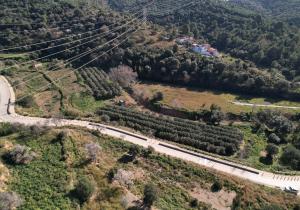
For centuries, Collserola was an agricultural landscape of vineyards, orchards, and olive trees, forming a mosaic of fields and forests.
Over time, the abandonment of farming activity has led to the disappearance of this mosaic, replaced by a continuous forest dominated by Aleppo pine, a highly flammable species.
This transformation of the landscape has increased the risk of large wildfires, especially during periods of drought and strong winds, putting both the natural environment and the inhabited areas of the massif at risk.
The solution
Restoring agriculture to reduce wildfire risk
The Fundació Catalunya La Pedrera is promoting a new line of action based on the recovery of traditional agricultural terraces and the production of quality food.
These terraces are traditional structures that help retain water, prevent erosion, and enable farming on sloped land.
Restoring them also means restoring a mosaic landscape, where agriculture and forest coexist and help reduce the spread of fire.
This model combines forest management, agricultural production, and social engagement, and aims to contribute to building a more climate-resilient Collserola.
2030 horizon
potentially recoverable for agriculture
Barcelona, Cerdanyola, El Papiol, Molins de Rei, Sant Cugat, Sant Feliu and Sant Just Desvern
Project horizon to consolidate a resilient agroforestry mosaic
Related news
Collaborating entities

La Diputación de Barcelona es una institución pública que apoya a los municipios de la provincia y trabaja por la gestión y conservación de los espacios naturales, a través del Área de Espacios Naturales e Infraestructura Verde.
Más información:https://www.diba.cat/es/area-d-espais-naturals-i-infraestructura-verda
L’Olivera es una cooperativa de trabajo y de iniciativa social que combina la producción agraria con la inclusión social. Cultiva viñedos y olivos y elabora vinos y aceites ecológicos, incorporando a personas con dificultades en todo el proceso productivo y situándolas en el centro del proyecto.
Con una trayectoria iniciada en 1974, impulsa un modelo de agricultura sostenible y de economía social que conecta territorio, alimentación y comunidad. En este marco, desarrolla los aceites urbanos, una iniciativa que recupera olivos en fincas periurbanas de Collserola y reivindica la agricultura de secano a partir de variedades históricas como la Arbequina y la Becaruda, con una mirada contemporánea al paisaje.
Más información: https://olivera.org/es/aceites/aceites-urbanos/
Collserola Iniciatives és una associació que agrupa propietaris i persones vinculades a activitats del Parc Natural de Collserola amb l’objectiu d’impulsar una gestió activa, coordinada i sostenible del territori.
En un context on més del 60% de la serra és de propietat privada, l’associació treballa per facilitar la gestió de les finques i promoure usos agrícoles, forestals i ramaders que contribueixin a recuperar el mosaic agroforestal i preservar els valors ecològics, culturals i paisatgístics de Collserola.
També impulsa la rehabilitació de masies i la recuperació del patrimoni rural, així com nous usos sostenibles que reforcin el vincle entre territori, activitat econòmica i comunitat.
The Collserola Natural Park is the great green lung of the metropolitan area of Barcelona, with more than 8,000 hectares of Mediterranean forests, crops and exceptional biodiversity. It is a key space for the environmental health of the region and is much loved by citizens for walking, doing sports and enjoying nature. Its management falls to the Consortium of the Serra de Collserola Natural Park, an entity formed by various public administrations that work together to conserve, protect and promote its sustainable use.
More information: https://parcnaturalcollserola.cat/